
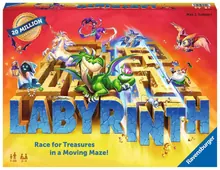


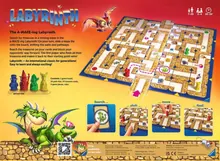
Family game
Labyrinth
Shift the maze walls to reach your treasures first
- Set-up
- About 3 min
- Reading
- None
The quick verdict
Full verdict ↓Great for Families with children of about 7 to 12 who like mazes and puzzle books
Think twice if You want an Indian-made or Indian-distributed edition; the classic box is currently an import only
How we rate it
Learning curve. A turn has two steps, push then move, and children of 7 pick it up in a game. The harder part is picturing how a push will change the paths, for you and for everyone else, which puts it at the easy end of 2 on our scale, a step above Connect 4.
Luck & skill. The random layout and the order of your treasure cards matter a lot: one player's treasures can sit close together while another's are on opposite sides. Within that, choosing the right push and planning a turn ahead make a real difference.
Interaction. Every push changes the maze for everyone, so you are always weighing a path for yourself against blocking the next player, and near the end everyone tries to keep the leader from getting home.
Set-up. Shuffle the 34 path tiles and lay 33 of them face up in the gaps on the board, turned any way, keeping one as the spare. Then deal out the treasure cards face down and put each pawn on its corner. It takes two or three minutes.
Reading. The board, tiles and treasure cards are all pictures. Someone reads the rules once; check that your copy has English rules, as German and Italian editions are also sold.
Learning curve: 1 = UNO or Connect 4; 3 = Catan; 5 = a heavy strategy game. These describe the experience, not an overall score.
Paid link · We may earn a commission, at no extra cost to you.
Is Labyrinth right for you?
Great if
- Families with children of about 7 to 12 who like mazes and puzzle books
- Mixed-language groups, since everything in play is a picture
- Two to four players looking for a game that ends in about half an hour
- Gifting, if you want a well-known Ravensburger classic and don't mind that it is an import
Skip it if
- You want an Indian-made or Indian-distributed edition; the classic box is currently an import only
- Someone in the group hates having their plans undone, because the next player can shove a row and wreck the route you were counting on
- Your children are under 7; Ravensburger's Junior Labyrinth is made for younger players
A place on the honours list
Good company to be in.
Recognition from beyond our table.
Spiel des Jahres, 1986 (Recommended)
How Labyrinth plays
The board is a 7x7 grid. Sixteen of its squares are printed path pieces that never move. The rest are filled with 33 loose path tiles, showing straight corridors, corners and T-junctions, laid out at random, and one more tile is left over as the spare. Each player puts a pawn in their own corner, and the 24 treasure cards are shared out evenly and kept face down.
- Time to teach: about 5 minutes.
- Reading and language: The board, tiles and treasure cards are all pictures, so nobody needs to read during play. Someone needs to read the rulebook once. Some copies sold in India are German or Italian editions, so check that the box you buy has English rules.
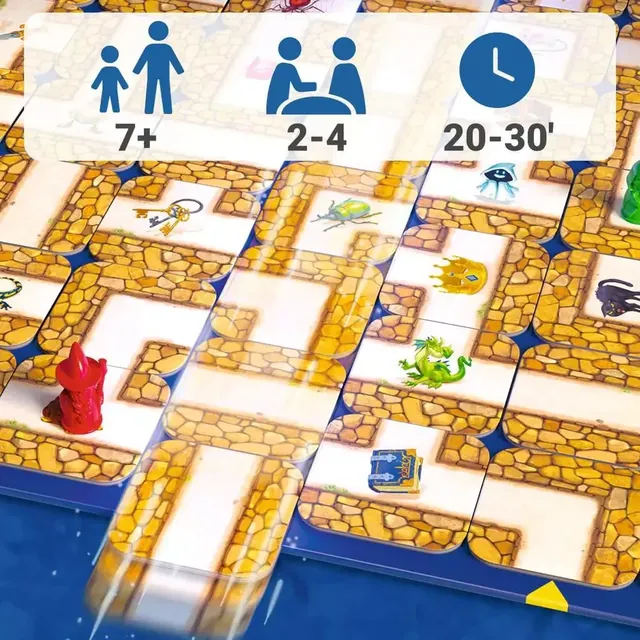
How to Play Labyrinth | The race for treasures in the moving maze · Ravensburger UK · Official
Choose a video · Watch right here
If this creator doesn’t allow embedded playback, watch on YouTube ↗.
A turn, step by step
- 1Push
Slide the spare tile into the board at one of the 12 arrowed slots on the edge. The whole row or column shifts by one square and a tile pops out the far side; it becomes the next spare, and nobody may push it straight back in where it came out.
- 2Move
Walk your pawn as far as you like along connected paths, or stay where you are. If you reach the treasure on your top card, turn the card face up and start hunting the next one.
- 3Win
Once all your treasure cards are face up, head back to your starting corner. The first player home wins.
The full explanation: how a game of Labyrinth goes
Every turn has two steps. First you must shift the maze: you push the spare tile in from the edge at one of the 12 marked slots, which slides that whole row or column along by one square and pushes a tile out of the far side. That tile becomes the next spare. You may not push it straight back in where it just came out. If a pawn is pushed off the board, it comes back on the newly inserted tile at the other end.
Then you move your pawn along any connected corridor, as far as you like. You look privately at the top card of your pile, which shows the treasure you are hunting, and try to reach the square with that picture.
When you reach your treasure, you show the card and look at the next one. The first player to collect all their treasures and get back to their starting corner wins.
Because every push changes the maze for everyone, you are always choosing between opening a path for yourself and closing one for the next player. For younger children, Ravensburger suggests a simpler version: all treasure cards are laid face up and players may go for any of them.
What's in the box
- 1Game board
36 x 36 cm, with 16 fixed path squares printed on it, including the four coloured starting corners - 34Path tiles
square cardboard tiles with straight, corner and T-shaped paths, some showing treasures; 33 fill the gaps on the board and 1 is the spare you push in - 24Treasure cards
each shows one treasure to find in the maze; shared out face down among the players - 4Playing pieces
one for each starting corner - 1Rules
English
Box: 37.3 × 27.3 × 5.5 cm. Handy to know for gifting and travel.
From Ravensburger's US and UK product pages for item 26448 (1 game board, 34 maze cards, 24 treasure cards, 4 playing pieces, instructions) and its English rules sheet, which adds that the board has 16 fixed path tiles. Ravensburger's German box (item 26955, Das verrückte Labyrinth) has the same board, tiles and cards and names its four figures as a wizard, a witch, a fortune teller and an apprentice; it comes with German rules.
Where to buy
Paid link · We may earn a commission, at no extra cost to you.
How to make sure you get a genuine copyEditions and the details worth checking.
What reviewers and players say
Labyrinth is one of the few family games that reviewers say children and adults genuinely enjoy together. Pushing a row and watching the paths change is satisfying, every game's maze is different, and nobody needs to read. The common complaints are a slow endgame with four players, when everyone blocks the leader on the way home, and turns that drag when someone weighs every possible push. Experienced adult gamers often find it light, and with two players it becomes more of a plan-and-block duel.
What people love
- Two-step turns that a seven-year-old picks up in one game, with no reading during play
- Pushing a row and watching the maze change is fun to do, and the random layout makes every game different
- Children can compete with adults on fairly even terms, and the treasure cards can be laid face up to make it easier for younger players
- Sturdy, thick cardboard tiles, and games short enough that another round is easy to start
Common complaints
- The endgame can drag: once someone is heading home, the others push rows to block them, and with four players that can take as long as the rest of the game
- Luck matters, because your treasure cards can send you back and forth across the board while a rival's are close together
- Players who study every possible push slow the game down, and groups of experienced adult gamers often find it too simple
Based on 7 reviews and discussions
- Review Labyrinth Board Game Review (Eric Mortensen, March 2016) · Geeky Hobbies
- Review Prepare to be aMAZEd: A Review of Labyrinth (Jennifer Derrick, December 2014) · iSlaytheDragon
- Review Family Staples: Labyrinth (Meeple Shelter, April 2022) · Meeple Shelter
- Players Anyone here play the Labyrinth game by Ravensburger? (November 2017) · Reddit r/boardgames
- Players Just opened Ravensburger Labyrinth and the tiles stuck most of the time (September 2026) · Reddit r/boardgames
- Award Das verrückte Labyrinth (1986) · Spiel des Jahres
- Reference Labyrinth (board game) · Wikipedia
Summarised in our own words from the sources above. We don't use Amazon reviews or ratings.
More like Labyrinth
Which game is the best fit?
Our picks if Labyrinth isn't quite right.
Swipe to compare every game
| Compare the games.The details that make a difference. |
YOU’RE VIEWING
 Labyrinth
|
ANOTHER WAY TO PLAY
 Carcassonne
|
ANOTHER WAY TO PLAY
 Ticket to Ride: First Journey
|
ANOTHER WAY TO PLAY
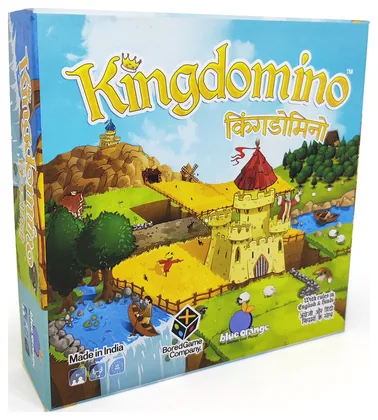 Kingdomino
|
|---|---|---|---|---|
| Why consider it | This game Shift the maze walls to reach your treasures first | A different fit Also about laying path tiles, for older children and adults who want more strategy | A different fit A route-building family game for ages 6 and up | A different fit Quick tile-placing for 2 to 4, with a short teach |
| Players | 2–4 | 2–5 | 2–4 | 2–4 |
| Best with | 2-4 | 2-4 | 2-4 | 2 or 4 |
| Play time | 20–30 min | 30–45 min | 15–30 min | 15–25 min |
| Age | 7+ | 7+ | 6+ | 8+ |
| Rules | Easy | Easy | Easy | Easy |
| Indian edition | Imported | Available | Imported | Available |
| On this page | Explore Carcassonne | Explore Ticket to Ride: First Journey | Explore Kingdomino |
More from Ravensburger
Another way into their collection.
More tile-laying games
Different games. A familiar kind of fun.
Carcassonne
Build a medieval map tile by tile, then claim it
Kingdomino
Build a tiny kingdom from land dominoes in twenty minutes
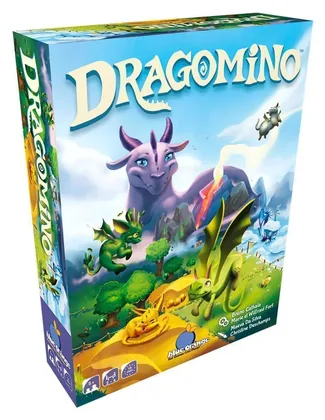
Dragomino
Kingdomino for five-year-olds: match landscapes, hatch baby dragons
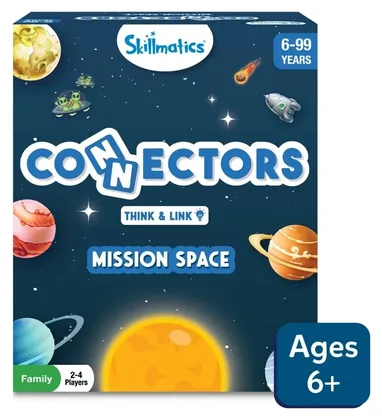
Connectors: Mission Space
Link picture tiles into a path through planets and galaxies

Qwirkle
Match colours or shapes to build lines of six tiles
Questions people ask about Labyrinth
Is Ravensburger Labyrinth sold in India?
Not by an Indian distributor, so every copy is an import. Our Check price on Amazon.in button goes to the genuine Ravensburger box (item 26448, the international edition with English rules). If you look at other listings, check the language, because German and Italian editions are also listed.
What is Junior Labyrinth?
Junior Labyrinth is Ravensburger's simpler version on a smaller board, made for younger children. Choose it if your child is under 7. The classic Labyrinth is for ages 7 and up, and adults play by the same rules.
Is the wooden ball 'labyrinth' the same game?
No. Wooden ball-in-a-maze toys, where you tilt a board to roll a marble past holes, are single-player dexterity toys. Ravensburger's Labyrinth is a board game for 2 to 4 players in which you slide rows of tiles to change the maze.
Can two people play Labyrinth?
Yes. The box says 2 to 4 players. With two, each player gets 12 treasure cards instead of 6, so the game runs a little longer, and you can plan your pushes knowing exactly who moves next.
Game facts
- Designed by
- Max J. Kobbert
- Publisher
- Ravensburger
- First published
- 1986
- Players
- 2–4
- Barcode
- 4005556264483
- Language
- No reading – The board, tiles and treasure cards are all pictures, so nobody needs to read during play. Someone needs to read the rulebook once. Some copies sold in India are German or Italian editions, so check that the box you buy has English rules.
- Box size and weight
- 37.3 × 27.3 × 5.5 cm
- Awards
- Spiel des Jahres, 1986 (Recommended)
Sources & photo creditsThe references behind this guide.
Facts on this page come from the publisher, the Indian maker or distributor, and the sources below. Photos are credited under each one.