

Party game
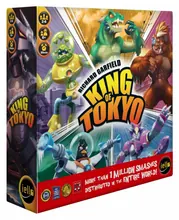
King of Tokyo
Roll dice as a giant monster and fight to rule Tokyo.
- Set-up
- About 5 min
- Reading
- Some
The quick verdict
Full verdict ↓Great for Families with children aged 8 to 12 who enjoy dice and monsters
Think twice if Your group dislikes luck – the dice decide a lot, and one bad roll can hurt
How we rate it
Learning curve. A turn is roll, keep, reroll, then act, which anyone who has played Yahtzee will pick up at once. The Power cards add a few extra rules to read, so it sits with Ticket to Ride and Kingdomino rather than with UNO.
Luck & skill. The dice drive almost everything, and a lucky roll can swing a game. You still choose which dice to keep, when to leave Tokyo and which Power cards to buy, so good choices help.
Interaction. Monsters attack each other directly: whoever is in Tokyo hits everyone outside, and everyone outside hits the monster in Tokyo. Players can be knocked out.
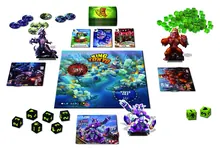
Set-up. Everyone takes a monster and sets its dials to 10 life and 0 points. Put the Tokyo board in the middle, shuffle the Power cards and turn three face up, and pile the energy cubes nearby. Use Tokyo Bay only with 5 or 6 players.
Reading. The dice and monster boards use only symbols, but every Power card has a short English text. Younger children may need someone to read the cards out.
Learning curve: 1 = UNO or Connect 4; 3 = Catan; 5 = a heavy strategy game. These describe the experience, not an overall score.
Paid link · We may earn a commission, at no extra cost to you.
Is King of Tokyo right for you?
Great if
- Families with children aged 8 to 12 who enjoy dice and monsters
- A group of four to six at a family function or festival night, when you want noise and laughter more than deep thinking
- Newcomers to board games – a turn is simply roll, keep some dice, reroll, then act
- A gift for a child who has outgrown Ludo and Snakes & Ladders
Skip it if
- Your group dislikes luck – the dice decide a lot, and one bad roll can hurt
- Someone hates being knocked out early – a monster that runs out of life sits out until the game ends
- You mostly play as a couple – two players can play, but the fight over Tokyo is livelier with more monsters, and King of Tokyo: Duel is made for two
A place on the honours list
Good company to be in.
Recognition from beyond our table.
As d'Or, Jeu de l'Année (France), 2012 (Nominated)
Lys Grand Public (Quebec), 2011 (Finalist)
How King of Tokyo plays
Everyone picks a monster and sets its board to 10 life and 0 Victory Points. The Tokyo board sits in the middle of the table. With 2 to 4 players only one spot, Tokyo City, is used; with 5 or 6 players a second spot, Tokyo Bay, opens up.
- Time to teach: about 10 minutes.
- Reading and language: The dice and monster boards use only symbols, but every Power card has a short English text explaining its effect, and the rulebook is in English. Children who don't yet read English comfortably will need someone to read the cards aloud.
King of Tokyo - How To Play · IELLO Games · Official
Choose a video · Watch right here
If this creator doesn’t allow embedded playback, watch on YouTube ↗.
A turn, step by step
- 1Roll
Roll the six black dice. You may set any aside and reroll the rest, up to three rolls in all, much like Yahtzee.
- 2Resolve
Use what you rolled: three or more of the same number score points, hearts heal you (but not in Tokyo), bolts give energy cubes, and claws hit other monsters. If Tokyo is empty you must move in; you score for being there but everyone outside attacks you, and you may leave when hit.
- 3Buy
Spend energy on any of the three face-up Power cards. Some give a lasting ability, others a one-off effect, and you can pay 2 energy to replace all three.
- 4Win
The first monster to reach 20 Victory Points wins, or the last monster still standing if everyone else is knocked out.
The full explanation: how a game of King of Tokyo goes
On your turn you roll six black dice. Much like Yahtzee, you can set some aside and reroll the rest, up to three rolls in all. The faces show the numbers 1, 2 and 3, an energy bolt, a heart and a claw.
Then you use what you rolled. Three of the same number scores that many points, plus one point for each extra matching die. Each claw wounds monsters: if you are in Tokyo you hit everyone outside, and if you are outside you hit whoever is in Tokyo. Hearts heal you, but not while you are in Tokyo, and energy cubes are saved for later.
Tokyo is the hot seat. If it is empty you must move in. You get 1 point for entering and 2 more each time you start your turn there, but you cannot heal and everyone outside is aiming at you. When another monster hits you, you may give up Tokyo and let the attacker take your place.
Three Power cards lie face up, and you can spend energy on them: 'keep' cards give lasting powers, while 'discard' cards have a one-time effect. You can also pay 2 energy to clear all three and reveal new ones. The game ends when a monster reaches 20 points or is the only one still standing.
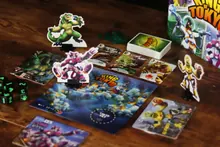
What's in the box
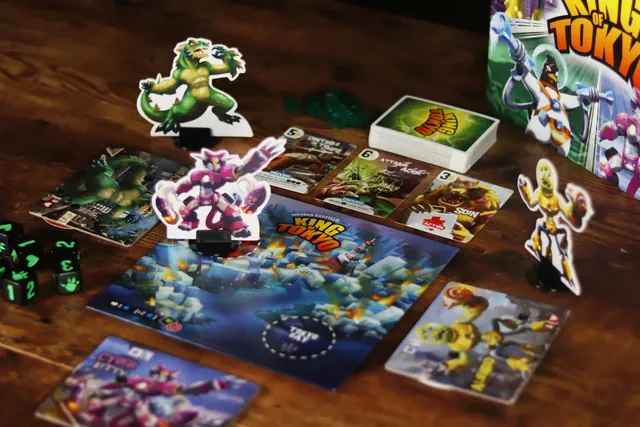
- 1Tokyo board
with two spaces, Tokyo City and Tokyo Bay; Tokyo Bay is used only with 5 or 6 players - 6Monster boards
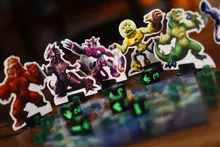
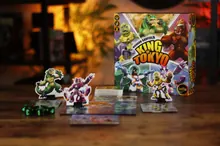
each with two dials, one for life and one for Victory Points - 6Monster figures
cardboard, with plastic stands - 6Black dice
symbols engraved on the faces: 1, 2, 3, claw, heart and energy bolt - 2Green dice
extra dice that only some Power cards let you roll - 66Power cards
each with a cost in energy and a short English effect - 50Energy cubes
green - 28Tokens
12 Shrink, 12 Poison, 3 Smoke and 1 Mimic, used by certain Power cards - 1Rulebook
8 pages, English
Box: 25 × 25 × 8 cm. Handy to know for gifting and travel.
Dice, tokens and the Tokyo board are from IELLO's current English rulebook. The card, energy cube and figure counts come from an Indian listing and a US listing for the same IELLO box (item 51314); a US library record for the 2015 printing lists the same numbers. The 2016 edition sold today has new artwork and swaps two of the six monsters compared with the 2011 original.
Where to buy
Paid link · We may earn a commission, at no extra cost to you.
How to make sure you get a genuine copyEditions and the details worth checking.
What reviewers and players say
King of Tokyo is a loud, quick dice game that reviewers recommend for families and mixed groups. They like that the rules take minutes, that the fight over Tokyo keeps everyone involved, and that each roll gives you several useful options, so bad luck rarely feels unfair. The main complaint is player elimination: a monster knocked out early has to sit and watch. Some also find it shallow, with every monster playing the same in the base game and some fiddly components.
What people love
- Rules take minutes to learn, and the Yahtzee-style rolling is familiar to almost everyone
- The fight over Tokyo means constant interaction, with lots of cheering and groaning around the table
- Every roll offers something (points, energy, healing or attacks), so the dice rarely leave you with nothing to do
- Big chunky dice and colourful, silly monster art that children enjoy
Common complaints
- A monster that runs out of life is out of the game and has to wait for the others to finish
- In the base game all six monsters play exactly the same, and the game is light on depth
- The figures are cardboard, the dials can slip, and some Power card combinations need a rules check
Based on 5 reviews and discussions
- Review King of Tokyo review (Tyler Nichols, June 2013) · Board Game Quest
- Review King of Tokyo review (Robin Curtis, August 2017) · Zatu Games blog
- Players Do dead monsters really have to leave the game? (December 2015) · Board & Card Games Stack Exchange
- Players What's the difference between King of Tokyo and King of New York? (June 2016) · Board & Card Games Stack Exchange
- Reference King of Tokyo · Wikipedia
Summarised in our own words from the sources above. We don't use Amazon reviews or ratings.
More like King of Tokyo
Which game is the best fit?
Our picks if King of Tokyo isn't quite right.
Swipe to compare every game
| Compare the games.The details that make a difference. |
YOU’RE VIEWING
 King of Tokyo
|
ANOTHER WAY TO PLAY
 Exploding Kittens
|
ANOTHER WAY TO PLAY
 Catan
Catan
|
ANOTHER WAY TO PLAY
 Sushi Go!
|
|---|---|---|---|---|
| Why consider it | This game Roll dice as a giant monster and fight to rule Tokyo. | A different fit Another loud, quick party game where players get knocked out | A different fit Dice drive this one too, but you trade and build instead of fight | A different fit Equally light and quick for family tables, with cards instead of dice |
| Players | 2–6 | 2–5 | 3–4 | 2–5 |
| Best with | 4-6 | 4-5 | 4 | 3-5 |
| Play time | 30 min | 15–20 min | 60–90 min | 15–20 min |
| Age | 8+ | 7+ | 10+ | 8+ |
| Rules | Easy | Easy | Medium | Easy |
| Indian edition | Imported | Available | Available | Imported |
| On this page | Explore Exploding Kittens | Explore Catan | Explore Sushi Go! |
More dice games
Different games. A familiar kind of fun.
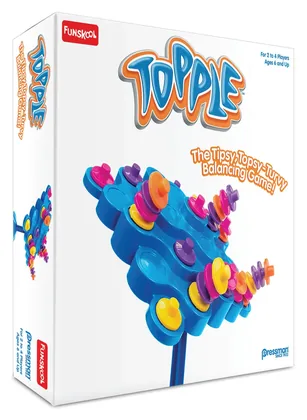
Topple
Roll, stack and score on a tower that tips and sways

Ludo
India's favourite race game: roll a six, cut and race home
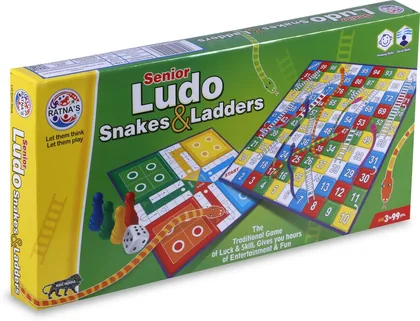
Snakes and Ladders
Climb the ladders, dodge the snakes, first to 100 wins
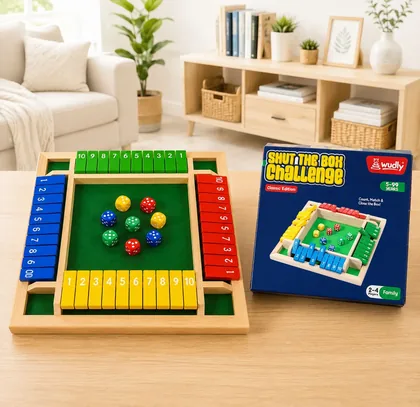
Shut the Box
Roll two dice, flip down the tiles, leave the smallest total

Monopoly Junior
Monopoly for little ones: one die, simple rules, half an hour
Also playable with two
For game nights with two players.

Jaipur
Two rival merchants trade goods and camels in old Jaipur
Snakes and Ladders
Climb the ladders, dodge the snakes, first to 100 wins
Shut the Box
Roll two dice, flip down the tiles, leave the smallest total
Monopoly Junior
Monopoly for little ones: one die, simple rules, half an hour
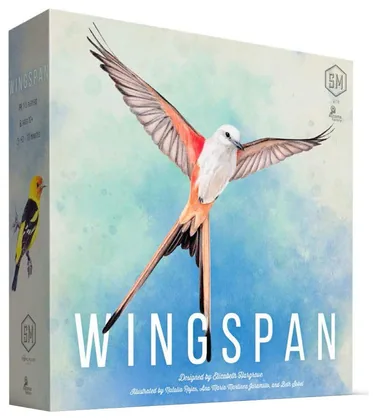
Wingspan
Calm card game about birds where every new bird boosts your turns.
Also worth a look (not in our catalogue yet): King of Tokyo: Duel – The same monster brawl, redesigned for exactly two players.
Questions people ask about King of Tokyo
Is King of Tokyo good for kids?
The box says 8 and up, and children can follow the dice easily because they use symbols. The Power cards have English text, so younger players may need someone to read them. A monster can be knocked out before the game ends, which upsets some children, so tell them about it before you start.
Which King of Tokyo should I buy in India?
Buy the standard IELLO King of Tokyo, the 2016 edition sold today; our Check price on Amazon.in button goes to that edition. The Monster Box adds expansions at a higher price, Origins is a simpler cut-down version, and Duel is a separate two-player game. The Dark Edition was a limited print.
Can you play King of Tokyo with 2 players?
Yes. The base game is for 2 to 6 players, and with fewer than five only Tokyo City is used. It feels much livelier with four or more, though. If you mostly play as two, King of Tokyo: Duel is designed for exactly two players.
Is there an Indian edition of King of Tokyo?
No. There is no Indian edition and no official Indian distributor for IELLO, so every copy is an imported English box. Our Check price on Amazon.in button goes to IELLO's 2016 English edition; make sure the brand is IELLO.
Game facts
- Designed by
- Richard Garfield
- Publisher
- IELLO
- First published
- 2011
- Players
- 2–6
- Barcode
- 3760175513145
- Language
- Some English – The dice and monster boards use only symbols, but every Power card has a short English text explaining its effect, and the rulebook is in English. Children who don't yet read English comfortably will need someone to read the cards aloud.
- Box size and weight
- 25 × 25 × 8 cm
- Awards
- As d'Or, Jeu de l'Année (France), 2012 (Nominated); Lys Grand Public (Quebec), 2011 (Finalist)
Sources & photo creditsThe references behind this guide.
Facts on this page come from the publisher, the Indian maker or distributor, and the sources below. Photos are credited under each one.
- IELLO – King of Tokyo (official game page)
- IELLO – King of Tokyo English rulebook (PDF, 11-2023)
- Wikipedia – King of Tokyo
- Gameistry – King of Tokyo
- Gameistry – King of Tokyo: Duel
- Gameistry – King of Tokyo: Monster Box
- Toycra – King of Tokyo Power Up Expansion
- Blackwell's – King of Tokyo (EAN 3760175513145)