


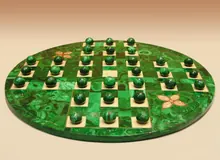

Traditional game
Brainvita
Jump marble over marble until only one is left, in the centre
- Set-up
- Under a minute
- Reading
- None
The quick verdict
Full verdict ↓Great for Children and grown-ups who like a quiet puzzle they can come back to again and again
Think twice if You want a game for a group: Brainvita is a one-player puzzle, though a family can take turns or race on two boards
How we rate it
Learning curve. The rules are as simple as games get: one kind of move. The difficulty is in the solving, since finishing with one marble in the centre takes most people many attempts and some careful planning.
Luck & skill. No dice, no cards and no opponent: every result comes from your own planning, and the same start position is always there to try again.
Interaction. It is a one-player puzzle. Families can take turns, compare how few marbles they finished with, or work out a solution together.
Set-up. Drop a marble into each of the 32 outer holes and leave the centre empty; resetting after an attempt takes under a minute.
Reading. Nothing to read; even the rules can be shown with a single move.
Learning curve: 1 = UNO or Connect 4; 3 = Catan; 5 = a heavy strategy game. These describe the experience, not an overall score.
Paid link · We may earn a commission, at no extra cost to you.
Is Brainvita right for you?
Great if
- Children and grown-ups who like a quiet puzzle they can come back to again and again
- A screen-free birthday present or return gift that needs no batteries, no reading and no second player
- Grandparents and grandchildren working on a solution together over a school-holiday afternoon
- Anyone who enjoys logic puzzles: there is real mathematics behind this little board
Skip it if
- You want a game for a group: Brainvita is a one-player puzzle, though a family can take turns or race on two boards
- There is a toddler at home: loose marbles are a choking hazard for children under 3
- Your child gives up quickly: most first attempts end with several marbles stranded on the board
How Brainvita plays
Brainvita is the Indian name for peg solitaire, also sold as marble solitaire. The puzzle first appears in France in the late 17th century: the French magazine Mercure galant printed its rules and a sample problem in 1697, and the engraver Claude Auguste Berey pictured the Princess of Soubise with a solitaire board beside her. A popular story says a nobleman locked in the Bastille invented it, but there is no evidence for that, and nobody seems to have recorded where the name Brainvita came from. The board most Indian sets use is the English cross of 33 holes; the French or European board, the one shown in the earliest records, has 37 holes, with four extra holes filling the inside corners of the cross.
- Time to teach: about 1 minute.
- Reading and language: Nothing to read at all. The single rule can be shown with one move, so it works in any language and for children who can't read yet.
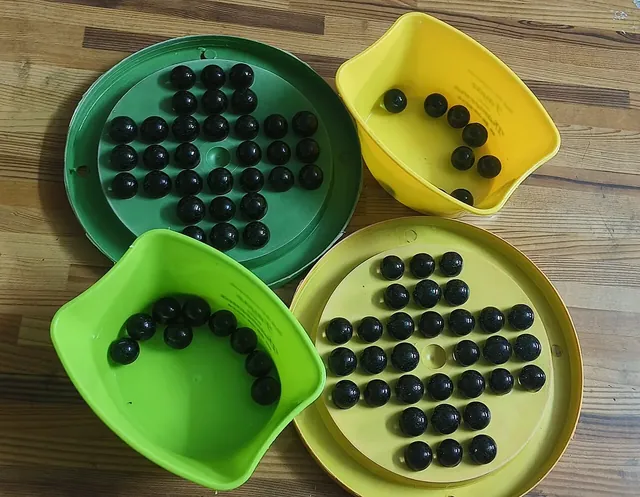
How to solve Brainvita/Marble Solitaire/Peg Solitaire game in simple steps · Advi's Diary
Choose a video · Watch right here
If this creator doesn’t allow embedded playback, watch on YouTube ↗.
A turn, step by step
- 1Set
Fill every hole with a marble except the centre one: 32 marbles on the standard 33-hole board.
- 2Jump
Jump a marble straight over its neighbour (up, down, left or right, never diagonally) into the empty hole just beyond, then take the jumped marble off the board.
- 3Plan
Keep jumping until no move is left. Clearing one arm of the cross at a time stops lonely marbles from getting stranded.
- 4Win
One marble left is a solve; one marble left in the centre hole is the perfect finish.
The full explanation: how a game of Brainvita goes
To set up, put a marble in every hole except the one in the centre, so a 33-hole board takes 32 marbles. There is only one kind of move: pick a marble, jump it straight over a neighbouring marble (up, down, left or right, never diagonally) into the empty hole just beyond, and take the marble you jumped over off the board. Every move removes one marble, so a perfect game is 31 jumps long. The very first move has to land in the centre hole, and there are only four ways to make it.
The goal is to finish with a single marble, and the perfect finish leaves it in the centre hole. Getting down to two or three marbles is a good first target; finishing with one in the centre on the English board is possible but hard, and most people need many attempts. Mathematicians have studied the puzzle closely: the shortest solution takes 18 moves if a chain of jumps by the same marble counts as one move, found by Ernest Bergholt in 1912 and proved shortest by John Beasley in 1964. On the 37-hole French board, starting with the centre empty, you can't get down to a single marble at all, so start with a different hole empty on that board.
A few tips that don't give the game away. Work on one arm of the cross at a time instead of jumping all over the board. Clear marbles in groups of three, using one 'helper' marble that jumps out and then jumps back in. Don't leave single marbles stranded at the tips of the arms: a lone marble with no neighbours is very hard to reach later. Keep the middle of the board for last, and if you get stuck, try the puzzle backwards from the end position you want.
Once you can solve it, there is more to try: finish in a different hole, start with a different hole empty, or try to leave a pattern of marbles on purpose, such as a cross. A single attempt takes about 5 minutes, and a family can take turns on one board or race on two. Keep the board on a tray or a mat so that marbles don't roll under the sofa.
What's in the box
- 1Brainvita board
Senior size, 33-hole cross layout; size and material not stated by the maker or stores - 32Marbles
colourful marbles, colours may vary; size and material not stated
From the listing title (32 marbles) and the Toysbox brand store's name for the set ('Senior Colourful Brainvita Board Game 33 Pieces', colour may vary), which we read as one board plus 32 marbles. No rules leaflet, lid or tray is mentioned. Toysbox's Mini Brainvita is a smaller board.
Where to buy
Paid link · We may earn a commission, at no extra cost to you.
How to pick a good setSize, pieces and the details worth checking.
What reviewers and players say
Brainvita is valued as a puzzle with the smallest possible rule and a surprisingly hard goal: rules writers describe it as having baffled people for centuries, and mathematicians have studied it for over a hundred years. People who grew up with it tend to talk about it with nostalgia, and the appeal is that anyone can start playing at once, yet the perfect finish feels like a real achievement. The common frustration is getting down to two or three marbles and being stuck, and once you have learned a solution by heart some of the mystery goes. With cheap sets, the usual complaint is marbles rolling out of shallow holes and going missing.
What people love
- One rule that anyone can learn in a minute, with no reading and no partner needed
- A real challenge: finishing with one marble in the centre takes planning and many attempts
- Plenty to try after the first solve, such as finishing in other holes or leaving patterns
- A quiet, screen-free puzzle that children and grandparents can work on together
Common complaints
- Getting stuck with a few marbles left over and over can be frustrating for younger children
- Once you've memorised a solution, it loses some of its pull
- Loose marbles roll away and get lost, especially with boards that have shallow holes and no lid
Based on 5 reviews and discussions
- Players Show HN: Peg Solitaire implemented in HTML, JavaScript, CSS (discussion thread, October 2019) · Hacker News
- Reference Rules of Solitaire (Masters Traditional Games, May 2025, updated September 2026) · Masters Traditional Games
- Reference Peg Solitaire (George Bell, no date shown) · gibell.net
- Reference Mathematics and brainvita (Notes on Mathematics, August 2012) · Notes on Mathematics (blog)
- Reference Peg solitaire · Wikipedia
Summarised in our own words from the sources above. We don't use Amazon reviews or ratings.
More like Brainvita
Which game is the best fit?
Our picks if Brainvita isn't quite right.
Swipe to compare every game
| Compare the games.The details that make a difference. |
YOU’RE VIEWING
 Brainvita
|
ANOTHER WAY TO PLAY
 Perplexus Epic
|
ANOTHER WAY TO PLAY
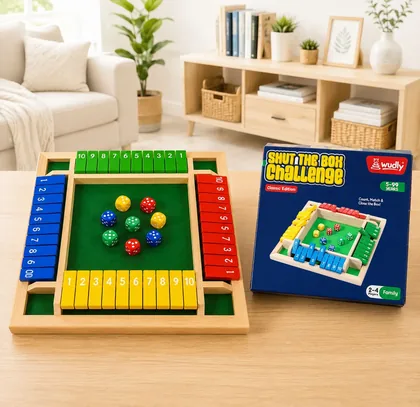 Shut the Box
|
ANOTHER WAY TO PLAY
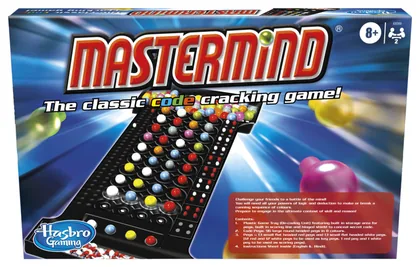 Mastermind
|
|---|---|---|---|---|
| Why consider it | This game Jump marble over marble until only one is left, in the centre | A different fit Another one-player puzzle that rewards patience and a steady plan | A different fit A classic you can play alone, with simple counting instead of jumping | A different fit A logic puzzle with coloured pegs for those who enjoy working things out |
| Players | 1 | 1 | 1–4 | 2 |
| Best with | 1 | 1 | 2-4 | 2 |
| Play time | 5–20 min | 5–60 min | 5–20 min | 10–30 min |
| Age | 6+ | 8+ | 6+ | 8+ |
| Rules | Easy | Easy | Easy | Easy |
| Indian edition | Available | Available | – | Available |
| On this page | Explore Perplexus Epic | Explore Shut the Box | Explore Mastermind |
More solo puzzles
Different games. A familiar kind of fun.

Questions people ask about Brainvita
Is Brainvita the same as peg solitaire?
Yes. Brainvita is the name used in India for peg solitaire, which is also sold as marble solitaire. The rules are the same everywhere: jump one marble over another into an empty hole and remove the one you jumped.
How many marbles are there in Brainvita?
The usual board has 33 holes and takes 32 marbles, with the centre hole left empty at the start. The less common French board has 37 holes and takes 36 marbles. Some sets include a spare marble.
Can Brainvita really be solved with one marble in the centre?
Yes, on the standard 33-hole board it can, though it takes most people many tries. The shortest known solution is 18 moves, counting a chain of jumps by one marble as a single move. On the 37-hole French board, a game that starts with the centre empty can never end with just one marble.
Who invented Brainvita?
Nobody knows who invented it. The earliest firm evidence is from France in the late 17th century, including a description of the board and rules in the magazine Mercure galant in 1697. The story that a prisoner in the Bastille invented it is a legend with no evidence behind it.
Is Brainvita safe for young children?
The game itself suits children from about 5 or 6, but the marbles are a choking hazard, so keep the set away from children under 3 and from younger brothers and sisters. Check that the box carries the ISI mark, which toys sold in India must have.
Game facts
- Publisher
- Toysbox
- Players
- 1
- Language
- No reading – Nothing to read at all. The single rule can be shown with one move, so it works in any language and for children who can't read yet.
Sources & photo creditsThe references behind this guide.
Facts on this page come from the publisher, the Indian maker or distributor, and the sources below. Photos are credited under each one.
- Toysbox brand store - Toysbox products (incl. Senior and Mini Brainvita)
- FirstCry - Toysbox Senior Colourful Brainvita Board Game 33 Pieces
- Hamleys India - Toysbox Brainvita Single Player Board Game, 5Y+
- George Bell - Peg Solitaire (history, boards, solutions)
- Masters Traditional Games - Rules of Solitaire
- Peg solitaire - Wikipedia
- Notes on Mathematics - Mathematics and brainvita (August 2012)
- India Briefing - BIS toy certification in India (Toys Quality Control Order)
- US eCFR - 16 CFR 1500.19, warning labels for toys with small balls and marbles